
Human Resource Development Minister Smriti Irani said a controversy over German being replaced in KV schools has been created "deliberately" and asserted that its continuation as third language would have been a violation of the Constitution.

Taking on her critics, Human Resource Development Minister Smriti Irani on Sunday dismissed charges that education was being saffronised even as she turned down demands that Sanskrit be made compulsory in the curriculum.

Members in the Rajya Sabha had sought the government's intervention in resolving the protests by JNU students by advising the university authorities to reconsider its decision to severely penalise some of them.

The Supreme Court on Friday asked the Centre to consider not replacing German language with Sanskrit in Kendriya Vidyalayas in the middle of the ongoing academic session and implement the decision from next academic year, saying, "Why are you punishing students for your mistake?"

What gets forgotten in the German vs Sanskrit debate is the poor standard of teaching in India.
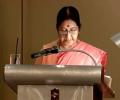
Speaking entirely in Sanskrit to over 600 Sanskrit experts, Swaraj called it a "modern and universal" language and said its tradition is comparable to the river Ganga.
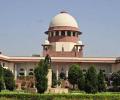
The Centre on Thursday submitted before the Supreme Court that Sanskrit will be the third language in classes six to eight in Kendriya Vidyalayas.

Union HRD minister says women in the country are not told what to wear, whom to meet and where to go.

'The threat to our pre-schoolers from the worst of Bollywood is far greater than the threat to Sanskrit from German.'

As education minister Smriti Irani should be worried about the state of education nationwide rather than fuelling a German-versus-Sanskrit row, says Sunil Sethi
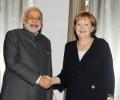
India's move to drop German as an alternative to Sanskrit as a third language in Kendriya Vidyalayas prompted German Chancellor Angela Merkel to raise the issue on Sunday with Prime Minister Narendra Modi who assured her of looking at it within the confines of the Indian system.

The Centre's move to celebrate Teachers' Day as 'Guru Utsav' and the planned interaction of the Prime Minister Narendra Modi with school children on that day have kicked up a controversy with opposition Congress and others, including Bharatiya Janata Party allies Marumalarchi Dravida Munnetra Kazhagam and Pattali Makkal Katchi, slamming the government.
It is time to reset expectations as government will move with alacrity on social policy, not on economic reforms.

When Modi's name was called out by the Secretary General for taking oath, Members from the ruling National Democratic Alliance thumped the desk greeting the Prime Minister with slogans such as 'Modi Modi' and 'Bharat Mata ki Jai'.

Taking a jibe at critics alleging saffronisation of education, Union Human Resource Development Minister Smriti Irani on Monday said the country's inherent strength in education, ancient concept and values is hailed and applauded abroad but is described as "saffron" back in the country.

Bharatvani, when it is complete, will revive languages in India that are on the verge of extinction.
The three humble Muslim entrepreneurs that the prime minister is mightily impressed by.

Devanik Saha wonders if saffronisation of India is on the rise

The RSS realises that with a majority BJP government at the Centre and in several states, now was the best time to undermine and perhaps outdo the Congress-Left 'stranglehold' over campuses and young minds.

Secretary general of CBCI Bishop Theodore Mascarenhas on what he doesn't like about the new education policy.

The Ambedkar-Periyar Study Circle explains their side of the story which saw the IIT-Madras student body being de-recognized for violation of code of conduct and misuse of privileges.

The year 2014 has been an eventful one for India. The country got a new government and a new state, broke new frontiers in various fields and of course its share of controversies.
